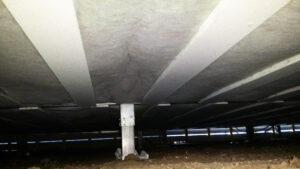
Choosing the Best Type of Underfloor Insulation
Choosing underfloor insulation is not quite the same as choosing ceiling or wall insulation. Under your floor is a tougher place to work. The insulation has to be fitted from below, held firmly against the underside of the floorboards, secured to the joists, and left to do its job in a space that may be dusty, cold, damp, awkward, uneven, full of pipes, or generally unpleasant. So the best underfloor insulation is not just the one with a nice-looking R-value on the pack. It is the one that can actually cope with life under a timber floor.
And after more than 20 years working in home energy efficiency and retrofit installation, our answer is very clear: for suspended timber floors, we recommend polyester underfloor insulation in roll format. Not because it is trendy or it has a nice brochure (it doesn’t!) But because we tested it, installed it, pulled it apart, got it wet, compressed it, stapled it, crawled around with it, (we even slept on it!) and we saw how it behaved in real homes over a very long period of time. That is where polyester proved itself. Without exaggeration, we believe we accidentally invested polyester underfloor insulation. Read our story here.
The quick answer
For most suitable suspended timber floors, polyester is the best type of underfloor insulation because it is:
- non-itchy and people-friendly to install
- durable and able to hold its shape
- moisture and mould resistant
- rodent resistant
- suitable for stapling securely to timber joists
- practical in roll form for retrofit installation
- removable and re-stapleable for future inspections or service access
- Made from recycled PET (plastic) bottles – better for the environment
Underfloor insulation has a harder job than you think
A ceiling is usually dry, protected and reasonably easy to access and a wall cavity is enclosed. But under a timber floor? That is a different universe. There may be moisture. There may be wind washing through the subfloor. There may be pipes, wiring, uneven ground, old timber, dust, spiders and mystery debris. The insulation has to stay exactly where it belongs: working against gravity – hard up against the underside of the floorboards.
If it drops down, sags, gaps, tears or slumps, you lose performance. The insulation may still technically be under the house, but it is no longer doing the job properly. That is why we care so much about the material. Underfloor insulation needs to be strong enough to install, stable enough to last, and forgiving enough to deal with the real world under Australian homes. The right kind of polyester does that beautifully.
Why polyester handles moisture better
Moisture is one of the key reasons we prefer polyester under floors. Subfloors are not always bone dry. A pipe can leak. A washing machine can overflow. A shower can fail. Rainwater can get where it should not. And even without a disaster, underfloor spaces can be exposed to humidity and damp air. Polyester is hydrophobic, meaning it does not readily absorb water in the way some other insulation materials can.
This does not mean you should install insulation into a wet, unhealthy subfloor. You should always fix moisture problems first. But it does mean polyester is totally forgiving if it gets damp after installation. Read more about what to do if insulation gets wet!
That matters enormously under a floor. Because an insulation product that has to be replaced every time it gets wet is not our idea of a good investment.
Why people-friendly installation matters
Some insulation products may be acceptable when they are sealed away in a ceiling or wall cavity and handled by someone in full protective gear. Underfloor retrofit is different. Someone has to crawl under the house with this product. They have to manoeuvre it into position, push it up between the joists, staple it securely, and keep working in a tight space. That is why we care so much about handling.
Polyester is non-itchy and non-irritant. That does not mean you ignore safety gear. Underfloor work still needs sensible clothing, eye protection, lighting and care (and an underfloor buddy plus a few good tunes). But it does mean the product itself is much nicer to work with. And when the job involves crawling around under a house, “much nicer to work with” is not a small thing. It may be the difference between finishing the job properly and quietly deciding you would rather move house.
Learn more Why Polyester Insulation Is a Safe and Eco-Friendly Choice for Under Your Home.
Why stapling matters so much
Underfloor insulation has to stay in contact with the underside of the floor. That is its job. It is fighting gravity 24 x 7, so it needs to be truly secure. It needs to be not near the floor, vaguely below the floor and definitely not drooping under the joists like a sad hammock. It needs to be hard up against the floor.
This is why we strongly recommend polyester insulation that can be stapled securely to timber joists. It has the structure and fibre strength needed to hold a staple, stay in place and maintain contact with the floor over time. Check out the “Types of Underfloor Insulation Exposed”. That is not a minor technical detail. It is central to performance. If insulation is not properly secured, it can sag, fall away, leave gaps and lose effectiveness. This is why the material and fixing method belong in the same conversation. A great insulation product installed badly is no longer a great result.
Why we do not rely on packing strap
Packing strap looks tempting because it seems simple. But underfloor insulation does not just need to be “held somewhere under the floor”. It needs to be supported properly, kept snug, and held in position over time. Loose fixing methods can allow insulation to sag away from the floorboards. Once that happens, performance drops. There is a school of thought that stapling is just too much trouble and packing strap will be quicker. Learn the 3 reasons why you should not use packing strap to install underfloor.
And gaps are not just bad thermally. They can also create cosy little invitation zones for pests. Polyester itself is not a food source, and no insulation should be called pest-proof, but poor installation can create spaces where pests may decide to move in. Your packing strap page makes this point clearly: loose or incomplete insulation can create pest-friendly gaps.
So the issue is not just “what product did you buy?” The issue is: Will it stay where it needs to stay?
With polyester, stapled properly to timber joists, the answer is yes.
Why ant and rodent resistant
Pests are another reason we prefer polyester underfloor insulation. Some insulation materials can contain glues or binders that may attract ants, while loose or poorly fitted insulation can create cosy gaps where rodents may nest. Polyester is heat-bonded rather than glued, so the fibres are fused together without relying on tasty binders. More importantly, it can be stapled firmly against the underside of the floor, which helps avoid the loose gaps pests love. No insulation should be described as completely pest-proof, but the right polyester product, properly installed, is a much smarter choice under a timber floor. Learn more: Ant and Rodent Resistant Underfloor Insulation.
Why spring-back and structure matter
Bulk insulation works because it traps air.
That means it needs loft. It needs structure. It needs to hold its shape. If insulation compresses and does not reloft, slumps over time, or pulls away from the floor, it loses performance. This is especially important under floors because gravity is working against you from day one. Polyester has excellent spring-back. It can be compressed during handling and then will recover its shape over time. (Note: Open your insulation bags so soon as they arrive so your insulation has time to reloft. Do not leave your insulation in compression bags for a long period of time). Polyester insulation has the strength to be handled, torn in the right direction, fitted into awkward spaces and secured without collapsing.
This is one of the things we tested early, because we needed to know what would happen not just on installation day, but years later. Underfloor insulation should not be a short-lived “well, that looked nice when it was installed “product. It need to keep doing its job.
Why rolls are better under floors
Underfloor retrofit is much easier when the insulation comes in long rolls. Rolls can be fed under the house, run along the joist bays, and installed with fewer joins. Fewer joins means fewer opportunities for gaps, less fiddling around, and a cleaner, more continuous result. That matters because underfloor installation is already awkward enough. You do not want to spend your weekend under the house trying to piece together a thermal patchwork quilt. Long rolls make practical sense. For retrofit underfloor insulation, rolls are not just convenient. They help you get a better result.