What Is the Best Insulation for Under Floor?
Ask a bunch of insulation retailers which underfloor insulation is best and there is a fair chance each one will point enthusiastically at whatever happens to be sitting closest to their highest profit margin.
ecoMaster is NOT insulation agnostic. We do not sell every product that can technically be shoved, strapped, sprayed, taped or wedged beneath a floor.
We spent more than 20 years installing home insulation and energy-efficiency products before becoming an online retailer thanks Covid 🙁 We have crawled under houses, worked around the pipes, dealt with all the odd joists (and their weirdo spacings), the damp corner and the unhappy wombat.
So we have seen what happens to insulation over time. We only sell underfloor insulation that we personally know can be installed properly, by DIYers, and continue performing for the long term. Not the product with the highest profit margin; not every product available. We only sell the options we would be prepared to put under our own floor.
The quick answer
For most existing Australian homes with an accessible suspended timber floor, our preferred option is:
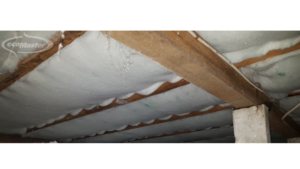
A purpose-designed R2.5 polyester underfloor insulation roll, correctly sized and stapled securely between the floor joists.
That is the short answer.
The slightly longer answer is that the best product depends on:
- what sort of floor you have
- how much access there is underneath it
- whether the joists are timber or steel
- the spacing between the joists
- moisture, pests and subfloor ventilation
- your climate
- how the insulation will be held permanently against the floor
- whether electrical cables, pipes or ducts are in the way.
We will tell you if our product is not suitable for your home.
We don’t want unhappy customers. Life is too short for that.
First: what sort of floor are we insulating?
“Underfloor insulation” can refer to several completely different jobs.
Suspended timber floors
These are common in older weatherboard, brick veneer and elevated homes. The floorboards are supported by joists with an accessible, or theoretically accessible, space underneath. This is the type of home most people mean when they talk about retrofitting underfloor insulation.
Polyester rolls, purpose-designed glasswool batts, rigid panels and some spray products may all be used beneath suspended timber floors.
Suspended concrete floors
A suspended concrete floor has open air beneath the slab rather than soil directly underneath it. These floors are more commonly insulated with rigid boards, foil-faced boards or professionally applied spray foam. To be fair, they are reasonably rare. We used a different type of insulation and installation method for them.
Concrete slabs on the ground
A slab sitting directly on the ground is a different proposition. The best time to insulate underneath a slab is before the concrete is poured. Rigid high-density insulation boards can be installed beneath the slab and around its edges as part of the building design.
Once the slab has been poured, there generally is no accessible “underfloor” area to retrofit. The floor has won that argument by being made of concrete.
Slab-edge insulation may still be possible in some homes, but it needs careful consideration of drainage, foundations and termite-management systems.
This article primarily deals with retrofitting insulation beneath suspended floors.
What actually makes underfloor insulation good?
The best underfloor insulation is not necessarily the one with the most exciting brochure.
It needs to:
- Provide an appropriate R-value.
R-value measures resistance to heat flow. Higher is generally better, provided the product is suitable for the application and installed at its intended thickness. - Sit firmly against the underside of the floor.
Insulation hanging several centimetres beneath the floor is not giving you the result you paid for. - Fill the space without gaps.
Little gaps become convenient express lanes for heat to bypass the insulation. - Stays put.
Gravity does not take over after the installation is complete. - Cope with real houses.
Real houses contain pipes, wiring, blocking, irregular joists, old repairs and tight corners. Plus the occasional water spill, and yes, a cranky wombat. - Remain inspectable and serviceable.
Electricians, plumbers, pest inspectors and future owners may all access beneath the floor, run extra cables and find the leaky water connection. - Perform safely in the actual building system.
Moisture, condensation, fire performance, electrical safety, rodent resistance and termite inspection all matter.
With that in mind, let us look at the main contenders.
1. Polyester underfloor insulation rolls
Our verdict: the best all-round option for most suspended timber floors
Polyester insulation is a bulk insulation made from polyester fibres. All polyester products sold in Australia contain a substantial proportion of recycled PET plastic. Like other bulk insulation, it works by trapping tiny pockets of air that slow the movement of heat.
Purpose-designed underfloor polyester is supplied in long rolls and made wider than the space between the joists. The edges are turned down and stapled into the sides of the joists, holding the insulation snugly against the underside of the floorboards.
The advantages of polyester underfloor insulation
It is pleasant to handle
Polyester contains no glass fibres. It does not produce the familiar glasswool itch and is generally much easier to work with in a cramped subfloor.
When your nose is 300mm from the dirt and you are holding a stapler above your head, “pleasant to handle” stops sounding like a minor benefit.
It is flexible
Polyester can be shaped around pipes, blocking and irregular timber more easily than a rigid panel. It can be torn, while you are under the floor – you don’t have to measure, inch your way out, cut the insulation, inch your way back only to discover the “10mm trick” (10mm too long or too short for those who are new the the “10mm trick”).
It can also accommodate the variations in joist spacing that are common in older homes, by using the turn and tear method.
Long rolls mean fewer joins
Fewer joins mean fewer opportunities to leave gaps. A roll can be cut to the length of a joist bay and installed as one continuous piece.
It can be secured directly to timber joists
A purpose-designed polyester roll does not need a hopeful collection of packing straps slung beneath it. When sized and installed correctly, it is stapled securely along both sides.
It tolerates incidental moisture well
Polyester does not absorb water into its fibres. If it becomes wet from a minor spill or temporary leak, it will dry out once the source of moisture has been fixed. It will not go mouldy or need to be replaced. That does not mean you should install it beneath a permanently wet floor. Insulation is not a substitute for fixing drainage, plumbing leaks or inadequate subfloor ventilation.
It is suitable for DIY installation
Where access is safe, a homeowner can install polyester underfloor insulation using the correct stapler, staples, safety equipment and installation method.
The disadvantages of polyester underfloor insulation
It is not always the cheapest product on paper
A basic glasswool batt may have a lower purchase price. However, the cheapest product is not cheap if it sags, falls down or needs to be installed again.
It is bulky to transport
Insulation contains a tremendous amount of air. Air is thermally useful but can be expensive to freight around Australia. Some manufacturers (like Bradford CSR) have an exceptionally good distribution network which makes it viable to move insulation around.
Why we prefer polyester
Polyester is not the only product that can work beneath a timber floor.
It is the product that, in our 20+ years of experience, gives the best combination of:
- thermal performance
- durability
- secure installation
- DIY friendliness
- moisture tolerance
- rodent resistance
- flexibility
- comfort while handling
- long-term reliability.
That is why our underfloor range centres on purpose-designed polyester products such as Value Poly and Bradford Polymax.
We do not stock them just because they are polyester. There are brands of polyester we will not stock. We stock them because we know these brands work and we know the manufacturers stand alongside their product warranties.
2. Glasswool and mineral wool batts
Our verdict: capable products, but retention and installation matter enormously
Glasswool insulation is made from fine glass fibres, often using a high proportion of recycled glass. Mineral wool products are made from mineral or rock-based fibres.
Both are bulk insulation products that trap air to slow heat movement. Purpose-designed underfloor glasswool batts are available, including products with a facing intended to reduce the effect of air movement beneath the floor – wind wash.
The advantages of glasswool underfloor batts
They can be cost-effective
Glasswool is widely produced and may offer a good R-value at a relatively low upfront price.
Purpose-designed products are available
A proper underfloor batt is different from simply grabbing leftover ceiling batts and pushing them into the gap between 2 joists. Some underfloor products are made with additional stiffness or a protective facing to improve their performance in an exposed subfloor.
They can provide acoustic benefits
Bulk fibrous insulation can help reduce some airborne sound transmission and make lightweight floors feel less hollow.
Some products have excellent fire performance
Fire performance varies by product, but non-combustible glasswool and mineral wool products are available.
The disadvantages of glasswool underfloor batts
They need reliable support
A batt fitted between joists must remain in contact with the floor above. A couple of narrow packing straps spaced a long way apart do not provide even support. The batt can slump between the straps, creating air gaps above the insulation. Straps can also stretch, loosen, break or pull away from their fixings.
If batts are used, the retention system needs to support them properly across the joist bay for the long term.
They are less forgiving of odd joist spacing
Pre-cut batts work beautifully when the house has read the packet and built its joists at exactly the expected spacing. Older homes have not always shown this level of cooperation. Narrow bays require cutting. Wide bays may need additional pieces, producing more joins and more opportunities for gaps.
Handling can be less comfortable
Modern glasswool products are generally much improved, and some are specifically marketed as low-itch. Even so, appropriate clothing, gloves, eye protection and respiratory protection may still be required when cutting and installing fibrous products.
That becomes more noticeable when you are crawling beneath a floor with the insulation right in your face, rather than standing upright in an open building frame.
3. Rigid foam boards and foil-faced panels
Our verdict: useful in a new build the right construction, but less forgiving in a retrofit
Rigid insulation panels may be made from materials such as:
- expanded polystyrene, or EPS
- extruded polystyrene, or XPS
- polyisocyanurate, or PIR
- foil-faced expanded polystyrene
- other composite foam boards.
Foilboard is one well-known Australian example. It has a rigid foam core with aluminium foil facings.
Rigid boards may be installed between joists or as a continuous layer beneath them, depending on the tested system and manufacturer’s instructions.
The advantages of rigid underfloor insulation
It is moisture resistant
Many rigid foam boards resist water absorption and are useful beneath suspended concrete slabs or in other appropriately designed applications.
It contains no loose fibres
Rigid board is generally clean to handle and does not release glass fibres during installation.
The disadvantages of rigid underfloor insulation
Every obstruction requires cutting and sealing
Pipes, cables, drains, blocking and irregular framing all need to be worked around. Every poorly cut edge creates a gap. Every gap reduces the continuity of the insulation and may allow air movement.
A beautifully regular new floor can be straightforward. The underside of a 90-year-old house may be considerably more creative.
Reflective performance depends on the whole system
A foil-faced board may advertise a high total system R-value.
That figure can include:
- the board itself
- a specified airspace
- the direction of heat flow
- the surrounding building materials
- the way joints and edges are installed.
It should not automatically be compared with the material R-value of a bulk insulation roll as though both numbers were measured in precisely the same arrangement.
The shiny surface is not personally generating extra insulation. It needs the tested airspace and installation system around it.
Joints need to be properly sealed
Where a system relies on a continuous foil or vapour layer, joints, edges and penetrations must be detailed correctly. That can be time-consuming in a retrofit.
Future access may be more difficult
Large sheets installed beneath the joists can conceal electrical cables, plumbing, timber and potential pest activity. Termite barriers and required inspection zones must remain visible.
Fire performance varies
Rigid foam products are not all the same. Their combustibility, fire-retardant additives, protective facing and approved applications need to be checked for the particular product and building.
When would rigid board be a sensible choice?
Rigid board may be particularly useful for:
- suspended concrete slabs
- new construction
- very orderly timber framing
- projects specifically designed around a continuous panel system.
It can work in an existing timber home, but “easy to cut” is not the same thing as “easy to fit perfectly around 47 pipes and a dozen mystery cables”.
4. Spray polyurethane foam
Our verdict: technically effective in some specialist applications, but not our preferred general retrofit solution
Expanding spray polyurethane foam is applied as a liquid and expands before curing into an insulating layer. It can adhere directly to the underside of timber flooring or a suspended slab and fill irregular spaces.
The advantages of spray foam
It can fill awkward shapes
Spray foam expands around irregular surfaces and penetrations that would require careful cutting with other products.
It adheres without a separate support system
Once correctly cured and bonded, it does not need straps or staples to hold it overhead.
It can provide insulation and air sealing
A continuous application can reduce both heat transfer and uncontrolled air movement.
The disadvantages of spray foam
The result depends heavily on the installer
Surface condition, temperature, moisture, mixing, application thickness and curing all affect the finished result. This is not a “give it a squirt and see how we go” product.
Installation involves chemical exposure risks
Professional spray systems require site isolation, protective equipment, ventilation, product-specific curing and re-entry procedures. Spray foam insulation beneath a house is not a DIY project.
It is difficult to reverse
Polyester insulation can be temporarily removed to access a pipe, inspect wiring or check the timber. Spray foam and the house become much more seriously committed. Future plumbing, electrical work, renovations and removal can be difficult and expensive.
It can conceal problems
Foam applied directly over timber, wiring or penetrations may make future inspection harder. Termite inspection access must be retained.
Moisture behaviour must be designed
Open-cell and closed-cell foams have different vapour properties. Applying the wrong product in the wrong location can affect drying and condensation within the floor.
Fire performance and protective requirements vary
The exact foam, substrate, location and required thermal or ignition barrier all need professional consideration.
When might spray foam be appropriate?
It may be useful beneath:
- irregular suspended concrete
- surfaces where mechanical fixings are difficult
- specialised engineered retrofits
- assemblies designed by an experienced building professional.
It would not be our default recommendation for the average homeowner wanting to insulate beneath accessible timber floorboards.
5. Insulating underlays, carpet and rugs
Our verdict: helpful additions, but not substitutes for underfloor insulation
Insulating underlay beneath carpet, floating floors or engineered timber can improve surface comfort and provide a small amount of thermal resistance.
It is particularly useful when flooring is already being replaced and the underside of the floor cannot be accessed. However, even a good quality underlay and carpet might rate R1.0. It will work well with an R2.5 insulation layer beneath the floor.
Carpet and rugs can make the surface feel warmer, but they do not properly insulate exposed floor joists, seal gaps or stop heat moving through the complete floor structure.
They are the thermal equivalent of putting on better socks, which is certainly better than bare feet.
Is it the same as insulating underneath your home house? No.
So which underfloor insulation is actually best?
Why R2.5 polyester is our usual recommendation
For an accessible suspended timber floor, R2.5 polyester provides a strong level of thermal resistance without becoming excessively thick or difficult to fit in most joist spaces.
The real ‘cost’ of an installation is actually in the effort / labour in installing it. Why would you install anything less than 2.5 if the effort was the same?
The installation can matter as much as the material
An excellent product installed badly can perform worse than a modest product installed carefully.
Whatever material is selected:
- install it against the underside of the floor
- fill each joist bay completely
- avoid gaps around pipes and blocking
- use the recommended fixing method
- support insulation continuously rather than with a few widely spaced straps
- keep termite barriers and inspection zones visible
- do not cover unsafe or damaged wiring
- fix leaks, damp and drainage problems first
- maintain required subfloor ventilation
- follow all electrical safety precautions.
Underfloor insulation is intended to slow heat flow.
Are we biased towards polyester?
Yes. But not because a polyester manufacturer bought us a particularly nice lunch. (They didn’t).
We are biased because we have installed underfloor insulation for more than two decades and have seen how different products behave in actual homes.
Polyester underfloor rolls are flexible, secure, pleasant to install and well suited to Australian suspended timber floors. We know how they need to be sized. We know how they should be fixed. We know what happens when they become temporarily wet. We know they can be removed and reinstated when someone needs access.
We also know that no product is right for every building. That is not insulation agnosticism. It is informed discrimination.
We sell what we trust.
Frequently asked questions
Is polyester underfloor insulation better than glasswool?
For most DIY retrofits beneath suspended timber floors, we believe polyester is the better all-round option because it is easier to handle, flexible, moisture tolerant and can be stapled securely to timber joists.
A purpose-designed glasswool underfloor batt can still perform well when installed with an effective retention system.
Is R2.0 or R2.5 better under a floor?
R2.5 provides greater resistance to heat flow than R2.0.
Where it suits the joist depth, climate and budget, we recommend R2.5 for suspended timber floors. The actual result still depends on complete, careful installation. An R2.5 insulation can be installed in such a manner than it does not achieve R2.5 performance. Don’t be that installer. Take your time, do it right the first time.
Can I use ceiling batts under my floor?
A generic ceiling batt may physically fit between floor joists, but that does not make it an underfloor system. There are some situations where that might be useful. Call us if you are considering this.
Can I hold underfloor insulation up with packing strap?
We do not recommend packing strap as the main support for soft underfloor insulation.
The insulation can sag between the straps and pull away from the floorboards. A product and fixing system specifically designed for underfloor installation is far more reliable.
Is polyester insulation rodent-proof?
Polyester is not a food source, but rodents may disturb or nest in insulation if your insulation has not been installed according to our recommendation. Don’t leave space for them to come and party.
Will underfloor insulation stop draughts through floorboards?
A snugly installed bulk insulation layer can substantially reduce air movement beneath and through a gappy timber floor.
However, large gaps and penetrations may still require separate draught sealing. Insulation and draught proofing work together, but they are not exactly the same job. How to seal floorboard gaps is fairly easy. Learn more here.
Can I insulate beneath a damp floor?
Fix the moisture problem first. Insulation should not be used to cover leaking plumbing, poor drainage, inadequate ventilation, mould, rotten timber or permanently wet soil. Once the cause is rectified, a moisture-tolerant product such as polyester may be appropriate.
The final verdict
For most existing homes with accessible suspended timber floors, the best underfloor insulation is:
A quality R2.5 polyester underfloor insulation roll, correctly sized, fitted snugly against the floor and stapled securely to the timber joists.
Not because polyester is the only material that insulates. Because after more than 20 years working in real Australian homes, it is the option we trust to be practical to install, comfortable to handle and reliable over the long term.
The best insulation is not the one with the loudest marketing or the biggest EOFY discount. It is the one still doing its job under your floor long after everyone has forgotten it is there.