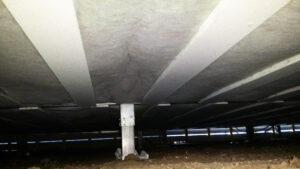
To work out if your home is suitable for underfloor insulation you need to consider type of floor you have; what’s going on under there; and whether there’s enough room to work. Here’s a breakdown of what to look out for when planning your underfloor insulation.
Number 1: What type of floor is suitable for underfloor insulation?
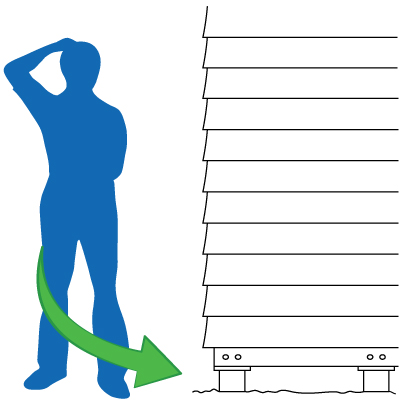 This is a simple question with a simple answer: if you’re on a concrete slab, you are not eligible for underfloor insulation. It may seem obvious but many people confuse underfloor insulation with slab heating. Underfloor insulation is installed from below your home, so it’s essential that you, or your installer, can get under there!
Your home is suitable for underfloor insulation, if:
– it has suspended timber floors
– there is safe access underneath the house
– there is enough room for someone to work safely
– the subfloor is reasonably dry
– there are no major hazards blocking the job
If you have steel joints, which is becoming much more common, take a look at our Joisties section.
Number 2: How much space is necessary to install underfloor insulation?
It’s less than you’d think! Installers only need 40cm clearance under a floor to install your insulation. That’s just a little bit under knee height.
But beware, houses are not always built on an even terrain and while some areas of your home will have enough space, others may not.
As a rough guide, if the space between the ground and the underside of your floor is so tight that you cannot roll onto your side – around 400mm – then the home may not be suitable for DIY installation. The floor itself may technically be able to be insulated, but the job may be too tight, slow or unsafe for a homeowner to do comfortably. Call us before you give up on underfloor insulation. We know exceptionally good – and very skinny – installers!
Number 3: Underfloor Access
The access point matters too. Some homes have a proper hatch, door or opening into the subfloor. Others have a very small, awkward or blocked entry point that makes the job much harder. You need to be able to get yourself, your tools and the insulation rolls into the space. If the insulation cannot physically be passed through the opening, that needs to be solved before the job can begin.
Successful access is where:
– Someone can get under the house. If the space between the underside of your floor and the ground is so tight that you can’t roll onto your side (about 400mm) then your home may not be suitable for DIY installation, even if the floor itself could technically be insulated.
– There is an access hatch, door or opening
– The access hatch is big enough to get installers and equipment through
– The insulation rolls can be passed through the opening
Number 4: Check The Conditions Under Your House
The condition of the subfloor really matters. A reasonably dry, clear and safe underfloor area is a much better candidate for insulation. If there is pooling water, mouldy timber, exposed wiring, sharp debris, pests or major obstructions, those issues should be dealt with first. Insulation should improve your home, not hide a problem that really needs attention.
When inspecting your sub floor, look for:
– Damp or pooling water
Do not install insulation where there is a wet subfloor. Find and fix the source of moisture first, improve drainage or ventilation if needed, and allow the area to dry properly before proceeding. You may need to consult a building professional if the source of the water cannot be easily located. This is a much bigger problem for you than delaying installing your underfloor insulation. Please act on it with haste.
– Mouldy or rotten timbers
Mould or rot is a sign that moisture has been hanging around for too long. Have the affected timbers checked and repaired before insulating, otherwise you may hide a structural or moisture problem instead of solving it. Once again, please consult a building professional. This may be the sign of a structural problem. Please act on it with even more haste.
– Asbestos risk
If you suspect asbestos, stop. Do not disturb the area. Have it assessed and safely managed by a licensed asbestos professional before anyone crawls under the house. There are a number of specialists who work in this area.
– Exposed wiring
Exposed, damaged or messy wiring needs to be checked by a licensed electrician before insulation is installed. This is a hard stop to any work. Electrical risks are easy to avoid when you have the right professionals around.
– Sharp debris
Remove broken glass, nails, metal scraps and other sharp objects before starting. A clean subfloor is safer to work in and makes the installation much easier.
– Pests
Deal with active pests before installing insulation. You do not want to create a lovely new hiding place for rodents, insects or anything else currently treating your subfloor as a holiday rental. To be fair – in all the years we installed underfloor insulation, the only ‘active’ rodent we encountered was a wombat. Can’t say I recommend insulating around wombats!
– Very uneven ground
Uneven ground may still be workable, but only if there is enough safe crawl space. If the ground makes access difficult or unsafe, the area may need to be levelled or treated as a non-DIY job.
– Pipes, ducts or obstructions
Pipes and ducts do not always stop the job, but they can slow it down or require careful work around them. Check that there is still enough room to install insulation snugly against the floor without crushing, blocking or damaging services.
If your subfloor is unsafe, damp or full of hazards, sort that out before thinking about insulation. Click here to learn more about DIY Safety Precautions
Do you have something slightly different?
Some homes need a slightly different approach. That does not always mean underfloor insulation is impossible, but the approach may been to change. If that is the case, contact us and let’s see if we can help you solve the issue.
When underfloor insulation is just not suitable:
Being big fans of the benefits of underfloor insulation, even we need to ‘call it’ when a home is just not suitable. 🙁
If your home falls into any of these categories, maybe there are other ways to improve the thermal comfort of your home:
- Your home is on a concrete slab
- There is absolutely no access under the floor, and none can be created
- The crawl space is too tight to work safely (but call us first, we know exceptionally good – and very skinny – installers!)
- If you have any of the “Number 4: Check The Conditions Under Your House” issues outlined above, that have not yet been resolved
Next Step:
Your home is suitable for underfloor insulation if your home has suspended timber floors, safe access, enough room to work and the sub floor conditions are acceptable.
If so, then the next step is choosing the right type of underfloor insulation.
What will it cost?
The cost of the insulation will depend on the size of your home. Contact us with the size of your home in square metres and we’ll email you a pricing estimate.
Not sure how to measure your home? Click here for a quick visual guide to measuring your home.