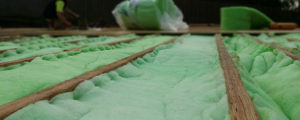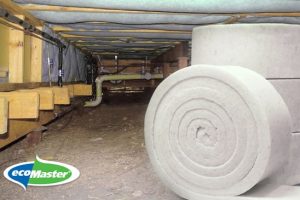
Stapling insulation is the best way to ensure your underfloor insulation withstands the test of time. While other bulk insulations like fibreglass has loose fibres that won’t hold a staple, our polyester insulation’s strong, heat-bonded fibres are perfect.
Stapling secures the insulation forever, pushing it firmly against the floorboards so it can do what it does best. Stapling also holds the insulation in place to prevent rodents from nesting between the floorboards and the insulation.
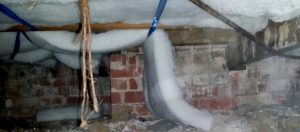
We only recommend stapling insulation because we want you to get the best value for your time and money. You don’t want the sad and saggy plastic strapping disaster in this picture to happen to you!
What Stapler Should I Use?
When stapling insulation under a floor, there are few things you need to know to ensure your safety and the quality of your job.
It is absolutely crucial that you only use electric or battery operated staplers when working under your floor. These types of staplers are double insulated, which means you can’t be electrocuted if you accidentally staple a wire under the floor.
ALWAYS use an RCD
When using a staple gun that plugs into a power source, we recommend working with a portable Residual Current Device (RCD) which is an effective add-on safety switch. It cuts the power supply instantly in the instance of an electrical fault of any kind.
Our Preferred Powered Stapler
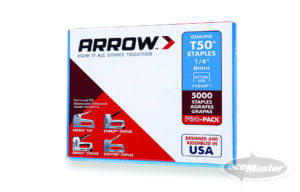
ecoMaster has used tons of staplers and staples over the years. A commonly available staple gun is the Ozito 8-14mm Staple Nail Gun. In our experience, these staplers work best with Arrow 10mm T50 Staples loading half a clip at a time.
Battery-Operated Cordless Staple Gun
If you have hard wood joists you might find that the Ozito is not quite powerful enough. Most people prefer to use a cordless stapler. We used and now hire out 12V Milwaukee Staplers with Battery and chargers in the Easy Install Kit. (This is for Melbourne customers only as it is pickup and drop back to our office).
Old-fashioned Metal Staple Gun
Never use ordinary metal staple guns when stapling insulation under a floor. These are not insulated and there is a very serious risk of electrocution. This is because the metal stapler is highly conductive and nothing will stop that electricity travelling to your body.
How many staples should I use?
For best results, choose 10mm galvanised staples. 10mm will be sufficient to penetrate even the hardest of hardwood timbers.
Allow 600 to 900 staples per PACK of insulation. We use Arrow 10mm T50 staples available on our webstore in either 1250 or 5000 packs.
Should I turn the power off before installing underfloor insulation?
Yes. We recommend turning the power off before you start working under your floor.
There is a bit of debate about this. Some people say, “I’m only installing insulation, I’m not doing electrical work.” Technically, that may be true. But under a house you may be crawling around near old wiring, damaged cable clips, junctions, previous DIY electrical work, rodent damage, damp ground, or cables you simply did not know were there. This is not the time to discover a surprise electrical problem.
Energy Safe Victoria’s general position is very simple: never work live and disconnect electricity before work starts where there is an electrical risk. WorkSafe Victoria also warns that wiring insulation can become brittle or damaged, and vermin can chew wiring, exposing live conductors.
The practical ecoMaster position
Turn the power off at the switchboard before installing underfloor insulation. Then:
- use battery-powered lights, not mains-powered leads running under the house
- let everyone in the home know the power is off
- place a note or tag on the switchboard so nobody helpfully turns it back on while you are underneath
- do not touch, move, staple, pull, squash or “tidy up” electrical cables
- keep staples well away from wiring
- stop immediately if you see damaged, chewed, old, brittle, loose or suspicious wiring
- call a licensed electrician if anything looks wrong
Turning the power off does not make old or unsafe wiring magically safe. It just removes one major risk while you are working.
Turn the Power Back On at Checkpoints — Not While You Are Working
Before you start installing underfloor insulation, turn the power off at the switchboard. But here is the part many people do not think about.
If you accidentally staple through an electrical cable, you may not know at the time. You might keep installing for hours, cover a large area, pack up, turn the power back on at the end – and then discover the power trips. At that point, finding the problem can be much harder because the offending staple could be anywhere in the area you have just insulated. A safer and more practical approach is to work in sections.
Every hour or so, or after you complete a clear section of the floor:
- Stop installing.
- Make sure everyone is out from under the house.
- Move tools, staplers and materials away from electrical cables.
- Turn the power back on briefly at the switchboard.
- Check whether the power stays on.
- Turn the power off again before anyone goes back under the floor.
If the power trips, cuts out, sparks, smells odd, or something clearly is not right, do not go looking for the problem by touching cables or pulling insulation around live wiring.
Turn the power off again and call a licensed electrician. The useful thing about checking at intervals is that it narrows down the problem area. If everything was fine an hour ago and now it is not, the issue is likely to be in the section you have just worked on. That information is very helpful for the electrician.
The repair is not your job. Electricians have the tools, testing equipment and training to find and fix electrical faults safely. A DIY installer does not.
So the rule is simple:
Power off while you work.
Power on only for a brief checkpoint when everyone is safely out.
If something trips, stop. Do not touch it. Call an electrician.